Transport Workers Union of America AFL-CIO
The Largest Air Transport Worker Union in the United States
Gallup: More in U.S. See Unions Strengthening and Want It That Way (August 2023)
We are a small organization, and we were once industry leaders in our profession. We can once more have a larger impact on our profession that not only improves our workplace but also helps to shift the direction of our industry. We desire to organize our fellow team members into a Labor Union that has the ability to represent and advocate on behalf of its members. This is just the starting point – organizing has many benefits that extend beyond wages, hours, and benefits, and we hope you will continue to read with an open mind and consider our goals as independent of other political or labor organizations. There’s a reason we ask that you consider this differently – organizing clinicians professionals working in Helicopter Air Ambulance (HAA) or Helicopter Emergency Medical Services (HEMS) has never been done before outside of hospital nursing Unions! We have the opportunity to create our own path and, in the process, make history with our own mission and values. We hope you will join us!
NMB Case No. R-7681: Certification Letter

Click here, and TWU will mail you an election authorization card with a postage-paid return envelope. 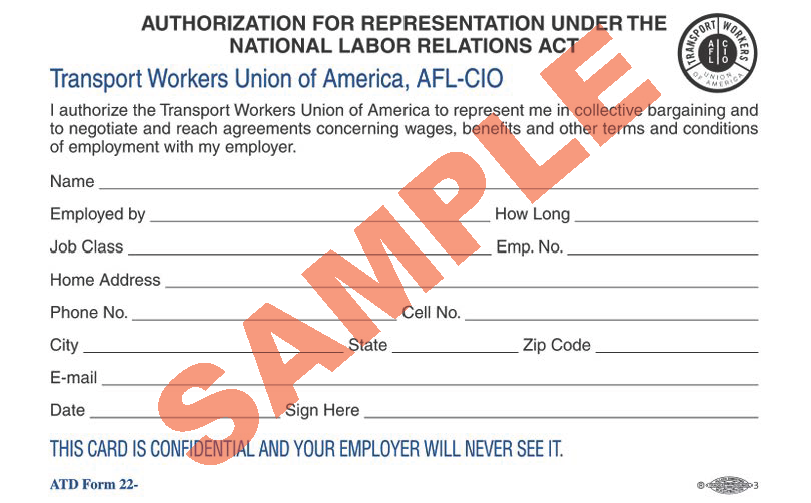
Questions will be answered within 24 hours.
Members submitting questions for public viewing will be posted here anonymously.
The Transport Worker’s Union (TWU) has a long history representing a wide range of workers and has been responsive and supportive throughout this process. Their organizers have been accessible, professional, and willing to help without imposing conditions that would exclude or diminish any group within our prospective bargaining unit. TWU also has experience negotiating with large, complex employers and sustaining long-term representation.
A strike is not our goal and is not part of our plan. We provide critical services, and our focus is improving pay, benefits, working conditions, and long-term program stability through negotiations, not disruption. Also, a strike is never a single person’s decision. It would require a democratic vote of the membership and would only occur after significant legal, procedural, and bargaining steps.
Generally, dues are equivalent to 2 hours of work at your BASE PAY per month. This is a very reasonable rate, and if you click here, you can read more in-depth about dues and the benefits that brings! There is also NO initiation fee, and dues will not be collected until there is a CBA in place.
To the best of our knowledge, they are not deductible on federal taxes, but some states do allow a deduction or credit. Please consult your financial planner to be certain.
No, none of the dues paid towards our future Local of the TWU would be directed towards political activities. If you chose to donate to a political cause on behalf or with the Union, you can – but it is not required or expected.
Absolutely! If we change our minds or decide to go in a different direction, we are not required to stay with this organization forever. The process is the same as what we are going through now, except we would be voting/petitioning to decertify the Union. The NMB will allow a decertification after two years from the date of certification
That’s a pretty broad question, and we can’t actually answer that. When you look at the Why? we have posted, that is just our preliminary ideas. The Union Leadership will do what the membership votes on and directs them to do, to the best of their ability. The what else all depends on you!
Well, not only is that a pretty terrible way to treat a subordinate, but it is also illegal. “…It shall be an unfair labor practice for an employer to interfere with, restrain, or coerce employees in the exercise of the rights guaranteed in section 157 of this title…” 29 U.S. Code § 158 Chapter 7 NLRA. More information on protected activities can be found here. For our campaign’s purposes, please refer to the section related to the “Railway Labor Act,” as we would be covered under that particular representation aspect as administered by the National Mediation Board (NMB). At this point in the process, we are actively working as a group of concerned and dedicated peers to improve our pay, benefits, and working conditions. We can talk about this openly. Despite that, let’s not poke the bear. Perform your duties as efficiently as always, check and double-check to make sure everything has been done. If a member of leadership threatens adverse employment actions, termination or bullying you need to document as much detail as possible about the situation and what was said, inform them that you believe this is an unfair labor practice, and contact one of us as soon as possible so that we can have those who are trained and educated to deal with these situations address it.
When workers begin organizing a union—especially in organizations where leadership has historically reacted emotionally—the initial backlash is usually predictable.
We should expect management to respond quickly and defensively. This often includes strong messaging framing the union as a “third party,” suggesting it will damage teamwork, flexibility, or the organization’s finances. Leadership may suddenly become more visible and communicative, holding mandatory meetings or issuing emails to push their narrative before workers can talk among themselves.
There may also be attempts to sow doubt or division, such as highlighting worst-case scenarios, questioning organizers’ motives, or implying that supporters are misinformed or acting out of self-interest. In some cases, leadership reacts by making short-term promises or policy changes to discourage momentum, without committing to lasting structural improvements.
We should also be prepared for emotional reactions—anger, dismissiveness, or a tendency to personalize the effort—rather than engaging with the actual issues driving workers to organize. That reaction, while uncomfortable, is often a sign that the effort is being taken seriously.
The key point is that this backlash is neither unusual nor a reflection of wrongdoing by workers. It’s a common response when employees begin asserting collective power. Staying calm, informed, and focused on the shared goals of fairness, safety, and a voice at work is the most effective way to navigate it.
Key Steps in the Union Election Process under the Railway Labor Act covering those directly employed by air carriers.
Ever wonder what the union-busting playbook looks like from one of the nation’s most notorious union-busting law firms? These are some of the things you could likely see and hear once the company finds out you’re organizing. It’s a scheme to scare you from forming a union. Although the playbook here describes an NLRB organizing scenario, this playbook can also be used in an NMB organizing drive like yours. Click here.
Want to hear more about union busting? Check out the video produced by APA. Click here.

Get latest news, event information, updates, and more.