This is the monthly edition of the Transport Workers Union’s Transportation Technology Newsletter. We aim to inform and educate our members, the labor movement, the public and policymakers about developments in transportation technology – and what the TWU is doing to ensure that new technology doesn’t undermine safety or harm the livelihoods of hard-working blue-collar workers. For suggestions and questions, please email ewytkind@gmail.com or adaugherty@twu.org.
ITEM OF THE MONTH
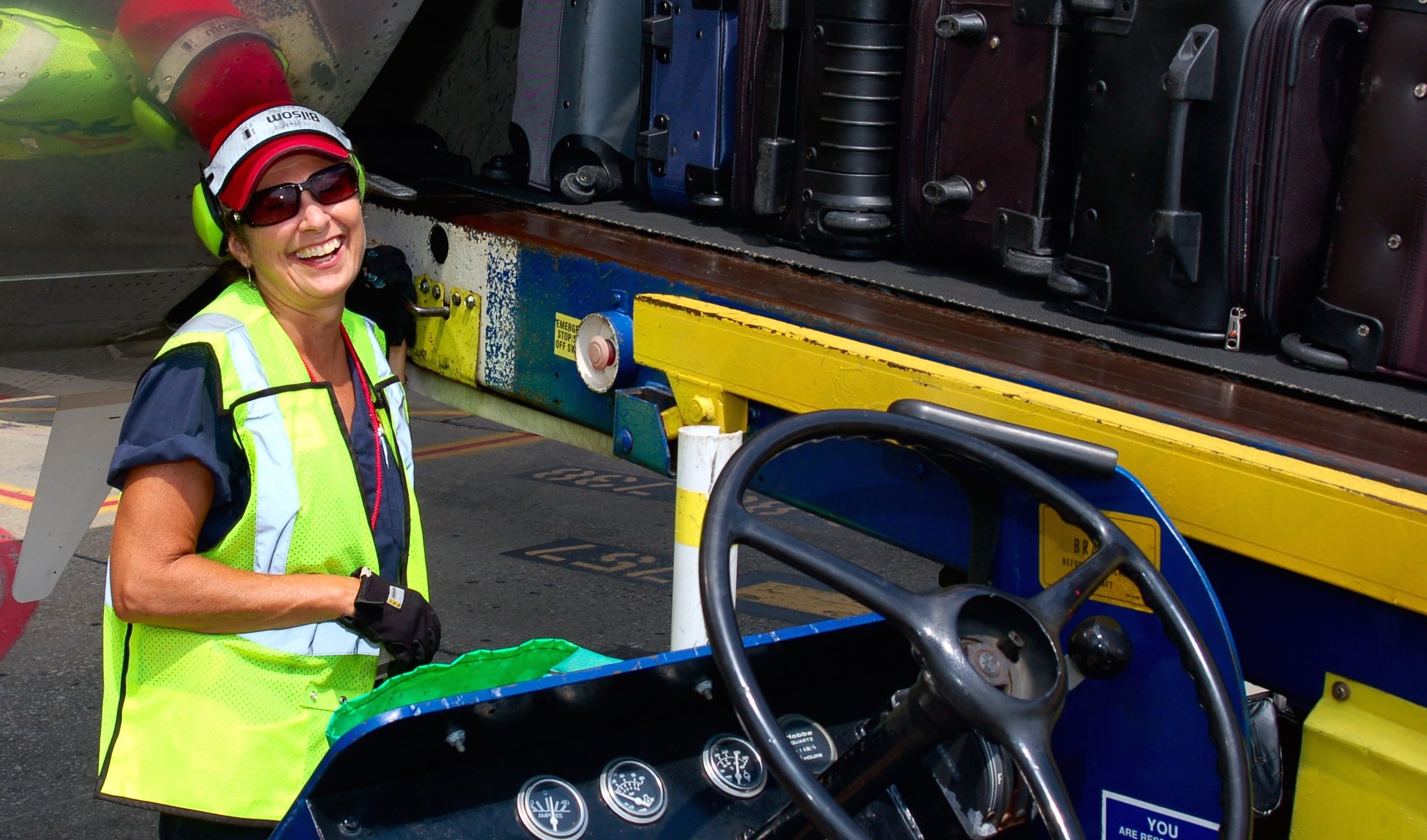
BIG IN JAPAN: Humanoid, robot baggage handlers are undergoing a trial run at Tokyo’s Haneda Airport, according to the Guardian and CNBC, with the Chinese-made robots performing baggage handling and cabin cleaning duties. The publications note that Japan Airlines, which operates flights to and from the United States, is facing labor pressure from an aging domestic workforce. But the robots are currently unable to perform many tasks on the job that require dexterity.
Marc Einstein, research director from Counterpoint Research, said the programming and reasoning skills in the humanoid robots are lacking and “they’re just not very smart yet.” The TWU, which represents Ramp Workers at Southwest Airlines, American Airlines, and more, strongly opposes any attempts in the U.S. to outsource human labor to robots.
“The bosses at every airline will be watching closely what happens in Japan to see how they can cut jobs. But the TWU will fight any attempt to replace skilled workers with foreign-made, insufficient robot technology,” said TWU International President John Samuelsen. “Just like we see with driverless cars, the technology might be able to perform basic job functions but fails epically when tasked with the challenging, real world situations TWU Ramp Workers face everyday at airports across the country.”
The World Economic Forum, in a recent blog post, described robot hand dexterity as the “last mile of robotic automation.” The WEF writes “Dexterity – the fine, contact-rich manipulation people perform without conscious thought – is the part of physical work machines still struggle with most. It is, precisely, the last mile of automation. Close it, and physical AI becomes economically transformative; leave it open, and humanoids remain impressive demonstrations rather than dependable workers.”
“It is clear that robots cannot replace human judgement, whether that’s split second decisions made on the ramp or while driving a bus in traffic,” said TWU Administrative Vice President Curtis Tate. “We will not stand aside as companies try to slash labor costs with robots that are not ready for the intense working environments transport workers face.”
WHAT ELSE IS COOKING
UBER ROBOTAXIS IN HOUSTON: Uber robotaxis are coming to Houston in mid-2027, Electrek reports, with riders using the company’s app to hail rides through the autonomous driving company Nuro. The company is currently testing vehicles on Houston’s roads, where TWU Local 260 represents workers at the Houston METRO bus and light rail system.
“Uber and Nuro see Houston as their test laboratory for autonomous transit,” Tate said. “It’s clear that cities around Texas where autonomous vehicles operate are faced with significant headaches, like Waymo robotaxis driving past stopped school buses in Austin. Houston, and TWU members who keep the city moving, will be worse off with autonomous vehicles using the city as a testing ground.”
Uber and Nuro, with vehicles built by Lucid, are attempting to expand rapidly. The company recently launched operations in the San Francisco Bay area and are planning to put 35,000 autonomous SUVs in dozens of markets in the coming years.
WAYMO OBSTACLES: The New York Times reports that Waymo is facing significant headways to operate in three of the country’s largest markets: New York, Chicago, and Washington DC. The Times reports that organized labor, including the TWU, has emerged as “some of Waymo’s most vocal opponents. And Waymo’s attempts to court those unions have had little success.”
A proposal from Waymo to create a fund for displaced workers in Illinois went nowhere in the state legislature. Janesse Lewis George, who is almost certain to be Washington DC’s next mayor, has publicly stated that the nation’s capital is “not ready” for Waymo. And the TWU was significantly involved in efforts to defeat a proposal from Gov. Kathy Hochul to expand the use of autonomous vehicles in New York State while working closely with New York Mayor Zorhan Mamdani to end the small-scale testing of autonomous vehicles on NYC streets that began under former mayor Eric Adams.
“The TWU and working people across the country are taking a stand – and winning,” Samuelsen said. “Autonomous vehicles were unleashed in the Bay Area and across much of the Sun Belt with little regard for how they would affect safety, workers, and the traveling public. What is happening in New York and other major cities across the country is a testament to the power of workers standing together to demand better instead of bowing to the wishes of Big Tech billionaires.”
GET OFF THE HIGHWAY: Waymo recalled its fleet of robotaxis to restrict them from driving on highways, TechCrunch reports, because of issues with how the vehicles behave around construction zones. The company identified at least 13 instances of Waymos driving into highway sections that were closed for construction. Six incidents happened in Phoenix and seven happened in the Bay Area.
This is the latest in a series of embarrassing recalls for Waymo. In May, Waymo service was suspended in Atlanta because the vehicles drove into flooded roads. A previous recall was issued after Waymos drove around stopped school buses while children were entering and exiting. And previous recalls have been issued for Waymos colliding with chains, gates, and telephone poles. And a Waymo user recently posted on LinkedIn that a robotaxi had deliberately locked seatbelts and he was forced to leave the vehicle.
“If a human driver did all of the things that Waymos have done on our roads in recent months they would have lost their license a long time ago,” Tate said. “Any politician or local government being courted by Waymo to unleash their vehicles on public roads only needs to spend five minutes reading about their serious safety issues to conclude that the traveling public shouldn’t be put in danger for job-killing tech that isn’t ready for primetime.”
SWEDEN BUS FAIL: Sweden’s premature launch of full-size Turkish-made autonomous buses on its roads had a crash landing, literally. On the day the service was inaugurated with actual passengers onboard, May 25, the 52-passenger driverless bus was rear-ended by a tram as the vehicle was abruptly braking, a common problem with this flawed technology.
“The Transport Workers Union has warned for years that this technology isn’t ready to unleash on our roads,” Tate said. “As we are seeing in the robotaxi sector, these so-called driverless vehicles crash, speed by parked school buses, drive into active crime scenes, and get confused by construction zones. It is time for government officials to stop this dangerous experimentation with passengers.”
This incident reignites a global debate about whether driverless vehicles of any size are able to navigate congested urban driving conditions at a time when robotaxis are causing chaos, constantly managing recalls, and exposing travelers to elevated safety risks on a daily basis.
PEPSI DEPLOYS DRIVERLESS TRUCKS: Gatik autonomous trucks will traverse Pepsi’s North American supply chain, according to a multi-year partnership announced this month by the beverage giant. Pepsi has deployed Gatik driverless trucks since 2022, with 41 rigs on the roads without an operator onboard in Texas, Arizona and Arkansas.
Pepsi boasts that it operates the largest deployment of fully autonomous delivery trucks in the United States, investing $600 million in the effort.
WHAT WE’RE READING:
Driverless Trucks Take Good Jobs Away From Americans. Wall Street Journal Opinion.
Use of Autonomous Wheelchairs Grows at Airports. Alaska News Source.
Volkswagen’s MOIA, Beep Push Autonomous Vehicles in Public Transit. Beep.
Trapped in a Haywire Waymo: SF Passenger Recounts Terrifying Construction Zone Ordeal. ABC7 San Francisco.