This is the monthly edition of the Transport Workers Union’s Transportation Technology Newsletter. We aim to inform and educate our members, the labor movement, the public and policymakers about developments in transportation technology – and what the TWU is doing to ensure that new technology doesn’t undermine safety or harm the livelihoods of hard-working blue-collar workers. For suggestions and questions, please email ewytkind@gmail.com or adaugherty@twu.org.
ITEM OF THE MONTH
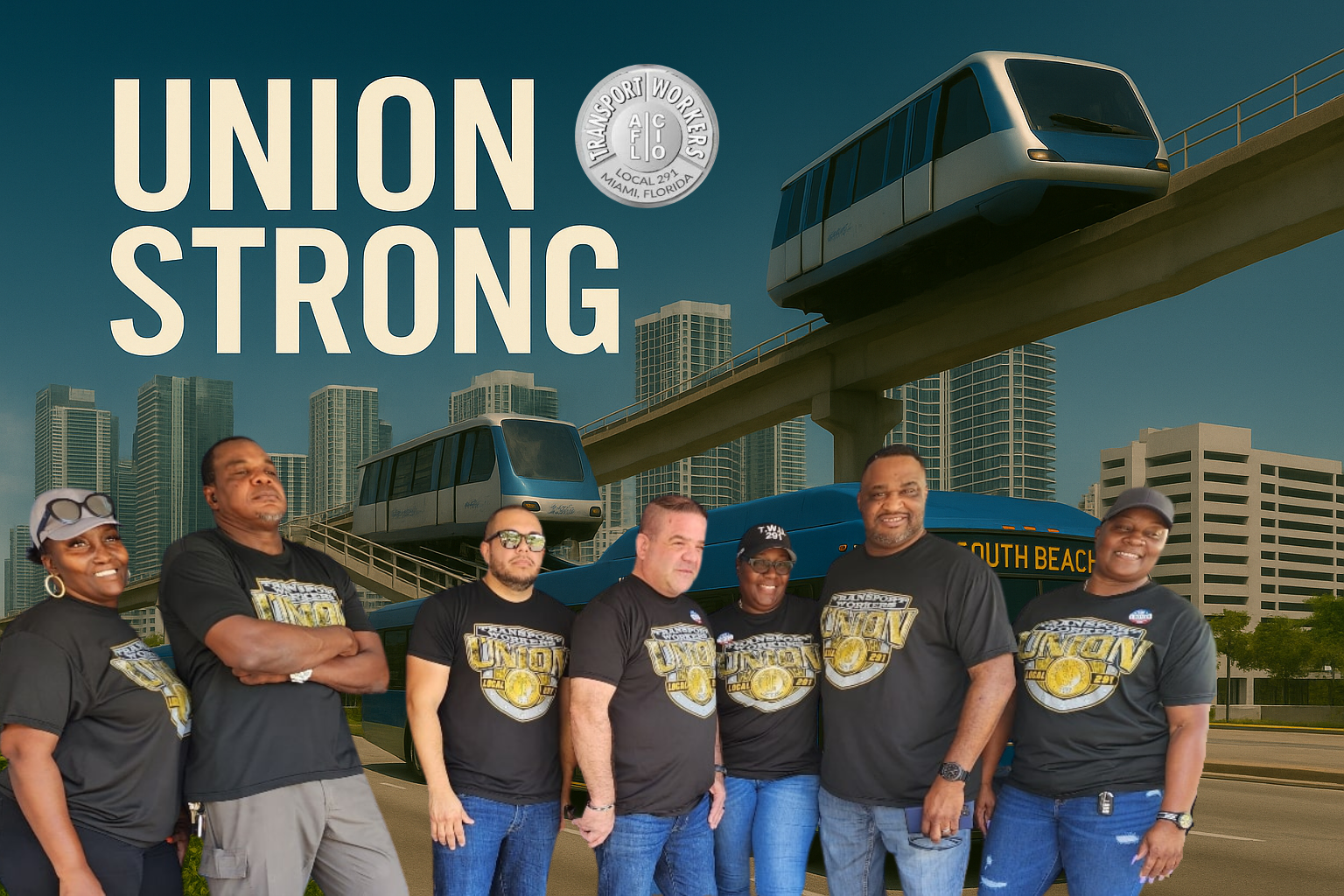
SAFETY BREAKTHROUGH IN MIAMI: TWU Local 291, led by local president Joe D’Elia, has secured breakthrough language in Miami-Dade Transit’s safety plan to ensure that no autonomous vehicle technologies are placed in service until safety risks are fully scrutinized and mitigated.
All transit systems are required to file a Public Transportation Agency Plan (PTASP) annually with the Federal Transit Administration. Before the plan can be submitted to federal authorities it must be approved by a safety committee composed of 50% management and 50% union representation and the system’s board of directors.
“Our strategic PTASP initiative has been an important element of our union’s transit safety agenda,” TWU International President John Samuelsen said. “With the rapid emergence of unproven and unsafe autonomous vehicle technologies, it is critical that we demand and secure the strongest safety protections against irresponsible deployment of driverless vehicles in our transit systems.”
The safety committee adopted language that prevents the implementation of autonomous technology for revenue service “until identified safety risks requiring mitigation have been addressed.” This allows the TWU in Miami to block the implementation of autonomous technology that isn’t ready for public use.
“Local 291 is committed to the highest safety standards for passengers and workers – that is our number one priority,” said D’Elia. “This agreement through our PTASP process ensures that the dangerous uses of autonomous vehicles we are seeing in the robotaxi sector don’t show up in the Miami-Dade transit system.”
WHAT ELSE IS COOKING
SPEEDING IN SCHOOL: NHTSA opened a safety probe into Tesla’s robotaxi service on October 9, Road and Track reports, after receiving reports of the company’s vehicles speeding in school zones. Three videos sent to NHTSA reported show autonomous Teslas operating in school zones while exceeding school zone safety limits. NHTSA is also investigating Tesla’s self-certification of its robotaxis, which do not have pedals or a steering wheel. This comes after Tesla sent a manual to first responders saying that physically pushing a disabled Tesla robotaxi is the way to clear blocked roads.
“Tesla’s blatant disregard for safety over and over again should give federal regulators pause when the company asks for exemptions to safety rules,” TWU Administrative Vice President Curtis Tate said.
EUROPE STEPS IN: Regulators in the European Union are forcing Tesla to rename their misleading “full-self driving” tech, Jalopnik reports, and now in Europe the system will be called “Tesla Assisted Driving.” Tesla CEO Elon Musk has repeatedly overstated the technology’s limits, though California state regulators eventually backed off from forcing Tesla to rename the tech in their state last year after the company specified that full-self driving must have driver supervision.
BAD MONTH: July saw Tesla report 236 crashes to federal regulators where driver-assisted tech was in use, the highest total ever recorded by the automaker, Electrek reports. That total, which included four deadly crashes, is almost certainly lower than the reality on the roads.
UNWANTED GUEST: Video out of Denver shows a Waymo vehicle stopped inside a busy farmer’s market, beyond barricades, CBS reports. The company told a local NBC affiliate it is “dedicated to learning from this situation.” Just two days earlier, a Waymo in the Denver area nearly drove over a road being paved by construction workers.
NO BLOCKING: California signed into law SB 1246, which penalizes robotaxi companies if they block police or firefighters from performing their duties for more than 30 minutes. The law, according to TechCrunch, also says robotaxi companies can only use remote drivers who are based in the United States and have a U.S. driver’s license. That could lead to a significant change for Waymo, which currently uses “remote operators” based in the Philippines who provide guidance and can send software commands, but the autonomous system remains in control.
LOCAL CONTROL: Waymo is now operating public rides in San Diego, but local officials are seeking to have more control over the robotaxis, with the Times of San Diego reporting that city councilmembers are asking the state for the authority to limit the number of robotaxis, where they can charge and park, and often they can roam around without riders.
“Thousands of San Diegans earn their living through taxicab, rideshare, transportation network company, and delivery driving,” a joint memo issued by the councilmembers said. “These jobs support economic mobility for local families and are a vital part of the City’s transportation network and economy…San Diego should demand that this technology deliver real benefits to the people who live here, not just profits to the corporations deploying it.”
GOVERNING BY EXEMPTION: Autonomous trucking company Aurora recently received an exemption from the FMCSA for a limited waiver for a specific cab-mounted beacon system that it claims is as safe as existing regulations for large trucks to use safety triangles when disabled by the side of the road (something an autonomous truck without a driver cannot do). The TWU has endorsed language in the upcoming surface transportation reauthorization that would require FMSCA to write a rule governing emergency stopping systems.
“Playing wack-a-mole with exemptions to safety rules that have been in place for decades is not a smart way to govern,” Tate said. “We need enforceable safety rules that take into consideration workers and the traveling public – not a process where a company can simply get permission to ignore the rules in certain instances.”
ZOOX SCARE: On the heels of another crash on the Las Vegas strip, Amazon’s robotaxi company, Zoox, is facing increasing safety scrutiny of its fleet of autonomous vehicles (AV) that apparently exposed workers to toxic gases requiring treatment at an emergency room.
TechCrunch reports that Zoox grounded its AV test fleet in Atlanta after as many as 40 workers may have been “exposed to carbon monoxide, carbon dioxide or hydrogen sulfide gas inside the vehicles.” One of those workers filed a complaint with the Occupational Safety and Health Administration evoking images of working conditions in Amazon fulfillment facilities.
“They made us go right back in the field after we said we were throwing up,” Jay Davis, one of the contractors who got sick in mid-August, told TechCrunch in an interview. “I emailed HR, told her what’s going on, and I told her I feel like it’s messed up that y’all made us go [back out].”
WHAT WE’RE READING
We’re Learning to Live with Waymos. It’s Getting Weird. The New Yorker.
From ‘hands free’ to ‘eyes-off’: how General Motors’ is simulating its way to autonomous driving. Associated Press.
London cabbies want Sadiq Khan to slam the brakes on robotaxis. The Register.
St. Paul City Council president wants robotaxi rules in place before big tech arrives. CBS News.
Workers erupt over DC plan to bring robotaxis to city streets. Fox News.