This is the monthly edition of the Transport Workers Union’s Transportation Technology Newsletter. We aim to inform and educate our members, the labor movement, the public and policymakers about developments in transportation technology – and what the TWU is doing to ensure that new technology doesn’t undermine safety or harm the livelihoods of hard-working blue-collar workers. For suggestions and questions, please email ewytkind@gmail.com or adaugherty@twu.org.
ITEM OF THE MONTH
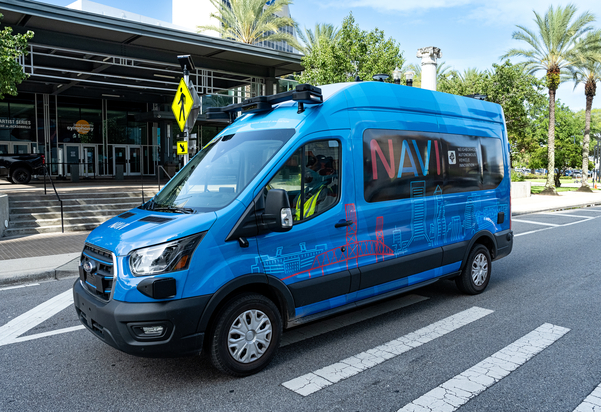
AV BUS FAILS IN JACKSONVILLE: Jacksonville, FL is poised to pull the plug on its poorly conceived autonomous shuttle service, NAVI, amidst a torrent of budget and legal woes, and criticism that this expensive project has drained vital public transportation resources. The budget troubles have also idled the city’s autonomous Skyway monorail service, whose infrastructure is reaching the end of its useful life and now must be upgraded or replaced.
“There is nothing surprising that an autonomous shuttle service has failed,” said TWU International President John Samuelsen. “What is surprising is that the state’s and the city’s transportation officials were fooled into investing $65 million into a flawed driverless system that has not improved mobility for the people of Jacksonville but has managed to drain the region’s public transit resources.”
The $65 million price tag for NAVI has drawn considerable criticism given that it only serves a single road for 3.5 miles, uses just 14 Ford 9-passenger vans, and averages fewer than 80 passengers daily in a metropolitan region of more than 1 million people. Streetsblog reports that local advocates are arguing problems with the service began long before the current fiscal crisis, with a transit agency chasing new technology while residents without cars have few transit options.
“It is time for federal, state and local lawmakers and regulators to end these dangerous experiments on our roads and in our transit systems,” Samuelsen added. “TWU will continue to press for strong and enforceable laws and regulations that force these Big Tech-funded providers to stop falsely advertising their services and to demonstrate that their technology is safe and does not undermine public transportation services and jobs.”
And transit agency employees spent their working hours riding the shuttle to boost sagging ridership numbers, Action News Jax reported last year, adding to the farce. In the end, Jacksonville spent $65 million on autonomous technology that still needed human operators at all times with absolutely nothing to show for it except bad headlines. It’s a cautionary tale for all public transit agencies and politicians enamored with grandiose promises from Big Tech.
WHAT ELSE IS COOKING
RAILING AGAINST ROBOT RAILS: NTSB Chair Jennifer Homendy recently accused the freight railroads for not implementing the board’s safety recommendations, while cutting training and resources. She also took colorful aim at the industry’s automation efforts in a speech reported by Politico’s Transportation team at BLET’s national convention in Las Vegas last month.
“You don’t get to build, operate, and maintain a system that demands perfection, strip away its safeguards … and then act surprised when a human being turns out to be human,” Homendy said. “And then turn around and say the answer is to get rid of the human. No fucking way. When tragedy strikes, the corporate script is all too familiar ‘He wasn’t following our operating rules, she wasn’t following the rules’ — that’s bullshit.”
Homendy had a message for unions as well, do not let NTSB safety recommendations collect dust and push the FRA and rail companies to make change. The TWU has repeatedly called out measures from the freight railroads that aim to cut headcount in lieu of safety, such as automated railcar inspections.
WAYMO TAILS COPS TRYING TO CLEAR HIGHWAY, NOW BANNED: Video shot by a driver and reported by NBC Bay Area shows a Waymo attempting to navigate around a California Highway Patrol traffic break on a Bay Area freeway. The CHP officer is forced to swerve in front of the Waymo who is repeatedly trying to pass the police car slowing down traffic temporarily so a work crew could clear debris on I-280.
The video prompted California to ban Waymo vehicles from traveling on freeways and the company temporarily stopped offering driverless rides on highways nationwide after California’s ban, the AP reports.
“Over and over again Waymo vehicles act in ways that would get you and I arrested – particularly on highways,” said TWU Administrative Vice President Curtis Tate. “Waymos have disregarded construction crews, blocked lanes, and in this case, a state trooper. When do we hold them accountable in the same way we would an aggressive human driver who attempts to speed around a police vehicle?”
The bad headlines and a recently stalled legislative effort in Washington DC haven’t appeared to stop Waymo. The AV company is beefing up lobbying efforts on Capitol Hill while aiming to double its fleet by the end of 2026 and quintuple its current 4,000 cars by the end of 2027, according to Semafor.
“Waymo is unabashedly expanding left and right and lawmakers need to take notice,” Samuelsen said. “It is critical that Congress passes a national federal standard for commercial AVs before they are put all over our streets. As Waymo is showing us, we must act now.”
AVs COMING TO MILITARY BASES: Task and Purpose reports that the U.S. Army is testing autonomous cars and vans at Fort Benning, Georgia as part of a Defense Department pilot to replace the military’s fleet of vehicles used for non-military purposes, such as moving supplies or transporting troops for training and ceremonies. Five companies, Applied Intuition, May Mobility, Perrone Robotics, Overland AI/Gatik, and Bot Auto are moving onto the next stage of testing vehicles in Georgia and at Fort Hood, Texas.
WHAT WE’RE READING:
Waymo Pilots Public Transit Rewards Program. Electrek.
Uber Plans Ramp Up of Robotaxis on its Platform. Smart Cities Dive.
Zoox Expands Las Vegas Service NBC 3 Las Vegas.